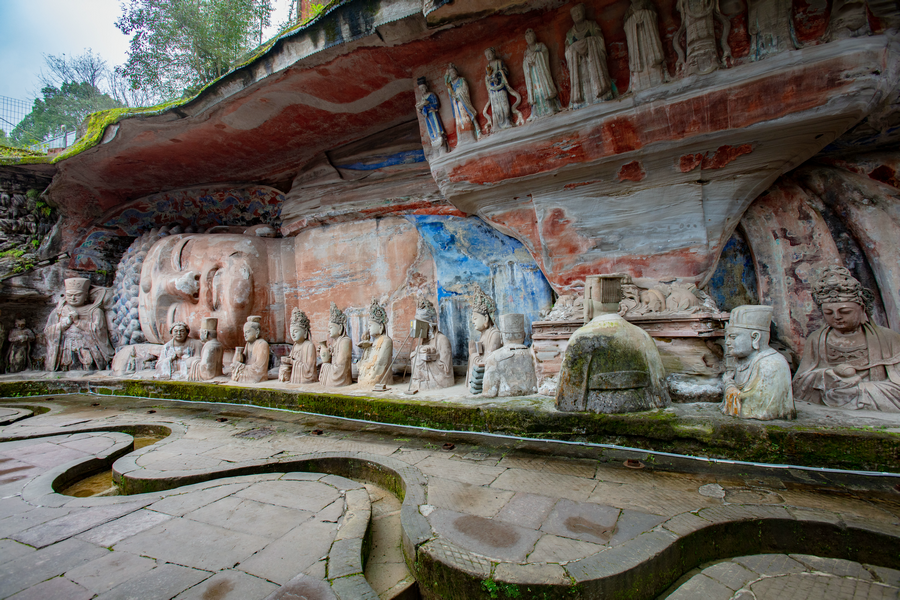
Dazu Rock Carvings
Overview
The Dazu Rock Carvings, located in Dazu county, Chongqing, China, represent an outstanding example of China's grotto art. These carvings, which began in the Tang Dynasty (618-907) and continued into the 17th century, encapsulate a millennium of artistic and cultural evolution. Recognized for their historical and artistic significance, the carvings were added to the World Heritage List on December 1, 1999. The site encompasses approximately 50,000 statues and around 100,000 Chinese characters inscribed across 75 cliff statue sites, all under state protection. The carvings stand out due to their impressive size, intricate craftsmanship, and exceptional preservation, making them a pinnacle of Chinese cave temple art.
What sets the Dazu Rock Carvings apart from earlier grottoes is their inclusion of Buddhist, Taoist, and Confucian figures, which reflect a synthesis of religious traditions. The carvings are known for their strong national and secular characteristics, depicting the daily lives and beliefs of ancient people. This integration of different religious figures marks the completion of the localization process of China's grotto art and highlights significant changes and developments in China's folk religion and artistic expression over time.
Historical Background
The historical significance of the Dazu Rock Carvings is deeply rooted in their long construction period, spanning from the Tang Dynasty (618-907) to the Qing Dynasty (1644-1911). The carvings were initiated during a time when grotto temples were a prominent feature of religious and cultural life in China, having been introduced along the Silk Road from India in the third century. The art form continued to thrive in Dazu even when it faded in other regions, absorbing local artistic styles and cultural influences.
The carvings reflect a range of historical influences, bearing witness to the evolution of religious beliefs and artistic styles over several dynasties. Notably, the Southern Song Dynasty (1127-1279) to the Yuan Dynasty (1271-1368) marked the pinnacle of carving work, especially under the guidance of a monk named Zhao Zhifeng. His work at Baodingshan, a site within the Dazu complex, became a focal point for Buddhist pilgrimage. Artisans of the time broke new ground by creating dynamic, life-like figures that departed from the more static images of their predecessors.
The carvings were relatively unknown to the outside world until the early 20th century. Since then, prominent Chinese historians and archaeologists began systematic research on the site, recognizing its significance comparable to other famous grottoes like the Mogao Caves. Extensive efforts have been made to protect, study, and promote the carvings, contributing to a deeper understanding of China's cultural and religious history.
Artistic and Cultural Significance
The artistic and cultural significance of the Dazu Rock Carvings lies in their exceptional craftsmanship, diversity of style, and thematic depth. The site is a testament to the maturity and innovation of Chinese rock art, showcasing a high aesthetic quality that reflects the artistic achievements of ancient China. The carvings exhibit a rich array of subjects, from grand Buddhist figures to intricate scenes of everyday life, effectively blending religious and secular themes.
One of the unique characteristics of the Dazu carvings is their synthesis of Buddhist, Taoist, and Confucian elements, which is rare among grotto temples. This integration illustrates the harmonious coexistence and mutual influence of different religious traditions in Chinese culture. The carvings also serve as valuable material for research into China's ancient culture, arts, philosophy, and social history, offering insights into the beliefs and practices of the time.
The carvings hold a special place in the hearts of the local community, representing a nostalgic link to their heritage. Generations of local residents have taken it upon themselves to protect and preserve the site, motivated by a deep-seated cultural reverence and a sense of responsibility to maintain its legacy. This community involvement underscores the enduring cultural significance of the Dazu Rock Carvings as a living part of China's rich historical tapestry.
Conservation and Exhibitions
The conservation of the Dazu Rock Carvings involves meticulous efforts to preserve and restore the delicate stone relics, which face threats from natural elements and human activity. Over the past decades, significant resources have been invested in restoration projects to address issues like water damage, rock instability, and the effects of environmental conditions. Notably, a comprehensive conservation and research project was launched to cover more than 60 medium- and small-sized sites within the Dazu complex.
Restoration efforts are guided by a commitment to maintaining the original aesthetic and historical integrity of the carvings. Advanced technologies, including three-dimensional scanning and electronic monitoring systems, are employed to ensure precise and effective conservation. International collaborations, such as a Sino-Italian joint conservation laboratory, have introduced cutting-edge restoration techniques and facilitated cross-cultural exchanges of expertise.
The carvings are also featured in exhibitions both domestically and internationally, helping to raise awareness and appreciation of their cultural value. The National Museum of China, for example, has showcased a selection of carvings and photographs to introduce the Dazu Rock Carvings to a wider audience. Additionally, 3D printing technology has been used to create replicas of the statues, making the art accessible to those unable to visit the site in person.
Key Locations and Features
The Dazu Rock Carvings encompass several key locations, each with distinctive features and artistic styles. Among the most notable sites are Beishan, Baodingshan, Nanshan, Shimen, and Shizuan mountains. These locations collectively house the majority of the carvings and are renowned for their intricate designs and cultural significance.
Beishan, also known as Northern Mountain, is famous for its dense concentration of grottoes and exquisite carving craftsmanship. Initiated during the late Tang Dynasty or Five Dynasties and Ten Kingdoms (907-960), the site was expanded over the centuries under the patronage of officials, scholars, and monks. The carvings here highlight the development of folk Buddhist beliefs and stone carving art in ancient China.
Baodingshan, or the "Mountain of the Precious Summit," is another prominent location known for its large-scale sculptures and thematic diversity. The site was a major center for Buddhist pilgrimage and features intricate carvings that encourage moral virtues, such as filial piety and ethical conduct.
Other locations within the Dazu complex, such as Nanshan, Shimen, and Shizuan, offer a variety of carvings that depict religious, historical, and everyday scenes. These smaller sites are part of a well-planned system, with some serving as barriers to the holy place of Baodingshan. Despite their lesser-known status, these sites are considered valuable for their historical and cultural insights, contributing to the overall significance of the Dazu Rock Carvings.
Article reference1. Dazu stone masterpieces on exhibit at national museum. chinadaily.com.cn. 20212. Exhibition shows Dazu Rock Carvings. chinaservicesinfo.com. 20213. Dazu Stone Carving Museum themes on grotto art. chinaservicesinfo.com. 20214. Dazu Rock Carvings. chinaservicesinfo.com. 2018Photo Gallery(28 pictures)CategoriesCultural HeritageTagLiterary MastersWorld HeritageWorld Heritage in ChinaTangible Cultural HeritageCultural LandscapeChinese SculptureRelatedShimenshan Rock CarvingsDazu Rock Carvings, ChongqingChinese Grotto ArtDazu Rock Carvings MuseumGames & QuizzesGrotto Greats: How well do you know China's cave art?Catalogue1. Overview2. Historical Background3. Artistic and Cultural Significance4. Conservation and Exhibitions5. Key Locations and Features-
- []








